Free Mac Softwares Download
UEFITool A74
UEFITool A74 for macOS is a full-featured, standalone, offline installer available for free download on IGetintomac.
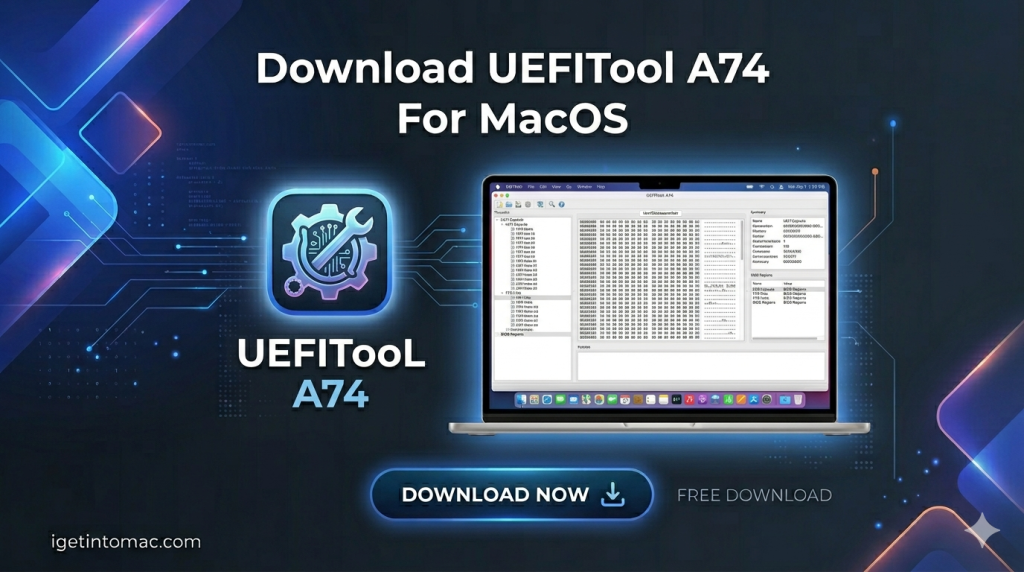
UEFITool A74 for macOS Overview:
UEFITool A74 for macOS is a very specific but highly useful tool for firmware reverse engineers, security researchers, and advanced Hackintosh tinkerers who require the ability to precisely parse, extract, modify, and rebuild UEFI firmware images. Unlike the other versions which are mostly for Windows, this one is built natively for macOS and provides a user-friendly Qt-based interface that supports both Intel and Apple Silicon firmware dumps, ranging from SPI flash backups to BIOS update capsules. The A74 release features better GUID parsing for Apple-specific PI volumes and a more robust FIT (Firmware Interface Table) recovery mode, which helps users to selectively remove malware DXE drivers or add custom NVMe modules to a Mac’s locked firmware. Although the tool does not guide you step by step or have a pretty interface, its true strength is in the “Parse” and “Extract body” features which reveal the hidden structure of your PC’s main processor. If you are willing to look into your Mac’s boot ROM, UEFITool A74 is your perfect instrument, precise, risky, and totally necessary.
UEFITool A74 for macOS Features:
- Native macOS Qt GUI Interface.
- UEFI Firmware Volume Parsing.
- GUID-Based Module Extraction.
- Firmware Image Rebuild & Insertion.
- Apple PI Volume Support.
- FIT (Firmware Interface Table) Recovery Mode.
- DXE Driver Injection & Removal.
- Raw Binary Hex Viewer.
- CRC16/CRC32 Checksum Validation.
- SPI Flash Dump Compatible (Intel & Apple Silicon).
Technical Details:
- File Name: UEFITool A74 macOS
- Version: A74.
- Release Date: April 16, 2026.
- Created By: LongSoft.
System Requirements:
- macOS 12 or later.
- Apple Silicon or Intel Core processor.
FAQs:
- Is UEFITool A74 safe for beginners to use on a Mac?
No. UEFITool is strictly for advanced users. Incorrect modifications—such as deleting critical DXE drivers or corrupting the boot volume—can permanently brick your Mac’s motherboard. Always work on a firmware backup and never flash modified images without proper hardware programmers. - Can UEFITool A74 open firmware dumps from Apple T2 or M1/M2/M3 Macs?
Yes, it can parse partial dumps and Apple-specific PI volumes, but note that Apple Silicon Macs use signed and encrypted secure boot chains. While UEFITool can view structures, you cannot flash modified images back without Apple’s private keys or a hardware programmer. - What file formats does UEFITool A74 support for input?
It supports raw binary (.bin, .rom), UEFI capsule files (.cap), Intel Flash Descriptor images, and BIOS update executables (after extraction). It does not directly open encrypted OEM update packages without prior decryption. - Can I use this tool to add NVMe boot support to an older Mac Pro’s firmware?
Yes. This is a common use case. You can extract the NVMe DXE driver from a newer firmware and insert it into an older Mac Pro’s UEFI volume using UEFITool A74, then reflash the modified firmware using a hardware SPI programmer. - Does UEFITool A74 run on macOS Sequoia and Apple Silicon Macs natively?
The tool runs via Rosetta 2 on Apple Silicon Macs, as it is compiled for Intel x86_64. No native ARM64 build exists for A74. It functions correctly under macOS Sequoia, provided you grant necessary disk access permissions.
Conclusion:
UEFITool A74 on macOS isn’t really a software for those who are new to it; it’s a hex command, a key to a door that most users don’t even realize is there. Its bare interface and no help at all might scare novice users, but firmware developers and boot-level brats will see it as a very handy tool for dissecting UEFI volumes on Intel Macs and Hackintosh systems. Version A74 adds a few nice Apple-specific features without changing the main thing: giving access to the very first code your Mac runs before the OS loader. As the rest of the world is putting increasingly stricter locks on the boot chains, UEFITool stays a totally open tool. Just make sure that with the big firmware powers you have comes the big firmware responsibilities, and always, always have a backup programmer handy.
Leave a Reply